 Hillary Lin, MD
What belongs
in practice?
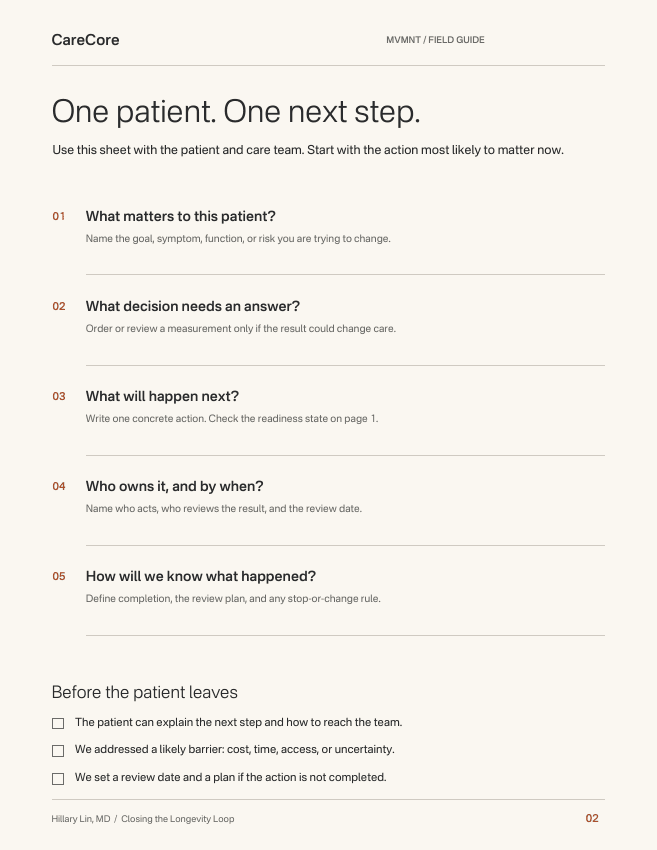
Assess the evidence for this use, this patient, and the decision you need to make.
- Ready now
- Evidence supports the use, and the result leads to a clear decision.
- Specific use cases
- A defined question, suitable patient, and action plan justify the choice.
- Too uncertain
- Name the missing evidence and what would make you reconsider.
- Evidence says no
- The claim has failed, or likely harm outweighs benefit for this use.
Make the next
step clear.
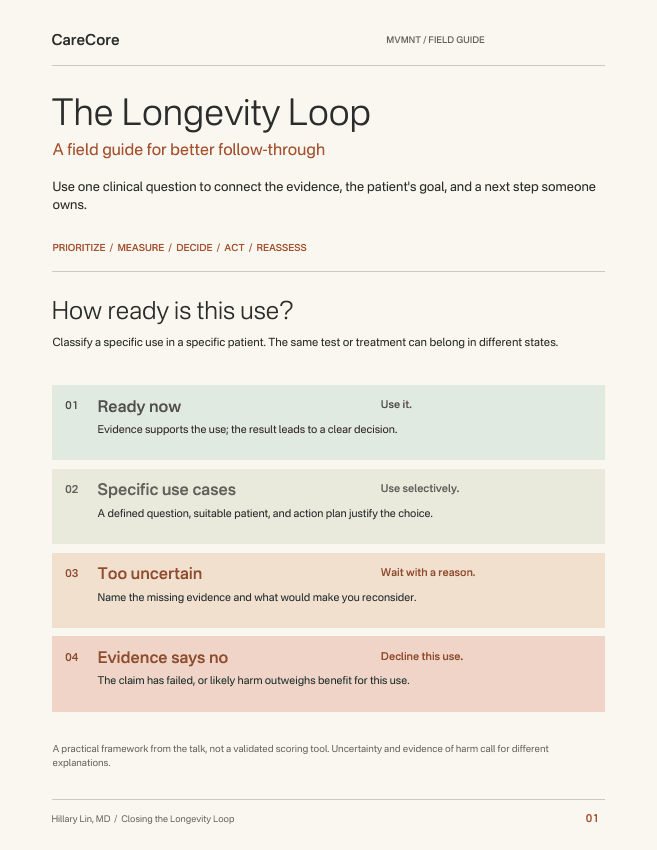
Leave the visit knowing what happens next, who owns it, and when to review it.
- What matters to this patient?Name the goal, symptom, function, or risk you want to change.
- What decision needs an answer?Choose a measurement only if the result could change care.
- What will happen next?Write one concrete action and check its readiness.
- Who owns it, and by when?Name who acts, who reviews the result, and the review date.
- How will we know what happened?Define completion and when to stop, change, or reassess.
Start with the patient.
In this illustrative case, a 56-year-old brings an office BP of 146/86, ApoB of 118 mg/dL, a father who had an MI at 54, and overdue colorectal screening.
Confirm the blood pressure with an agreed method and review date. Assess overall cardiovascular risk. Choose an appropriate screening option and track completion.
Sources: USPSTF hypertension screening; USPSTF colorectal screening.
Keep the guide
close at hand.
The readiness framework, a patient worksheet, and a worked case. Ready to print or keep on your desk.
Download the field guideFree · 3-page PDF
Building a longevity practice?
Bring your programs, community, and care together with CareCore.
Educational framework for clinicians. Apply current guidance and clinical judgment to each patient. Hillary Lin, MD is Co-Founder & CEO of CareCore.