Apple Gets Into Longevity. What Happens After the Score?
I’m probably buying the watch. I’m harder to sell on another health score.
By Hillary Lin, MD
· 7 min read
I’m far more interested in accurate, continuous data collection. Editorial illustration.
Apple gets into longevity.
Am I excited? Absolutely. But probably not about what you're thinking.
On September 9, Apple announced a redesigned Health app with a Longevity tab, Health Age, movement assessments, and a Quest panel of more than 50 biomarkers for $119. It arrives later this year. Apple announcement
Last year, I wrote about Apple saying “longevity” out loud. This year, it's putting more of the things people buy from longevity companies into its own Health app.
Which is interesting, to say the least, if you are in this industry.
We're now in year 3 of what I'd call the current consumer longevity era. Since the beginning, I have grown from being very enthusiastic, to now being pretty uninterested in interpretation and synthesis platforms.
Instead, I am far more interested in accurate, continuous data collection.
For example, I've found health-age scores directionally helpful, but noisy. Across various proprietary devices and platforms, I've mostly stopped paying close attention to mine, given they're all over the place.
That leaves a pretty basic business question: if my phone can organize my results and explain them, what makes me pay for another service?
Oura, WHOOP, and Ultrahuman already combine bloodwork with wearable data. Function and InsideTracker sell testing and interpretation too. Apple has plenty of company here. Oura, WHOOP, Ultrahuman, InsideTracker
I wanted to know how those lab businesses are actually doing, so I dug a bit deeper. There is real demand, although the numbers companies share answer very different questions.
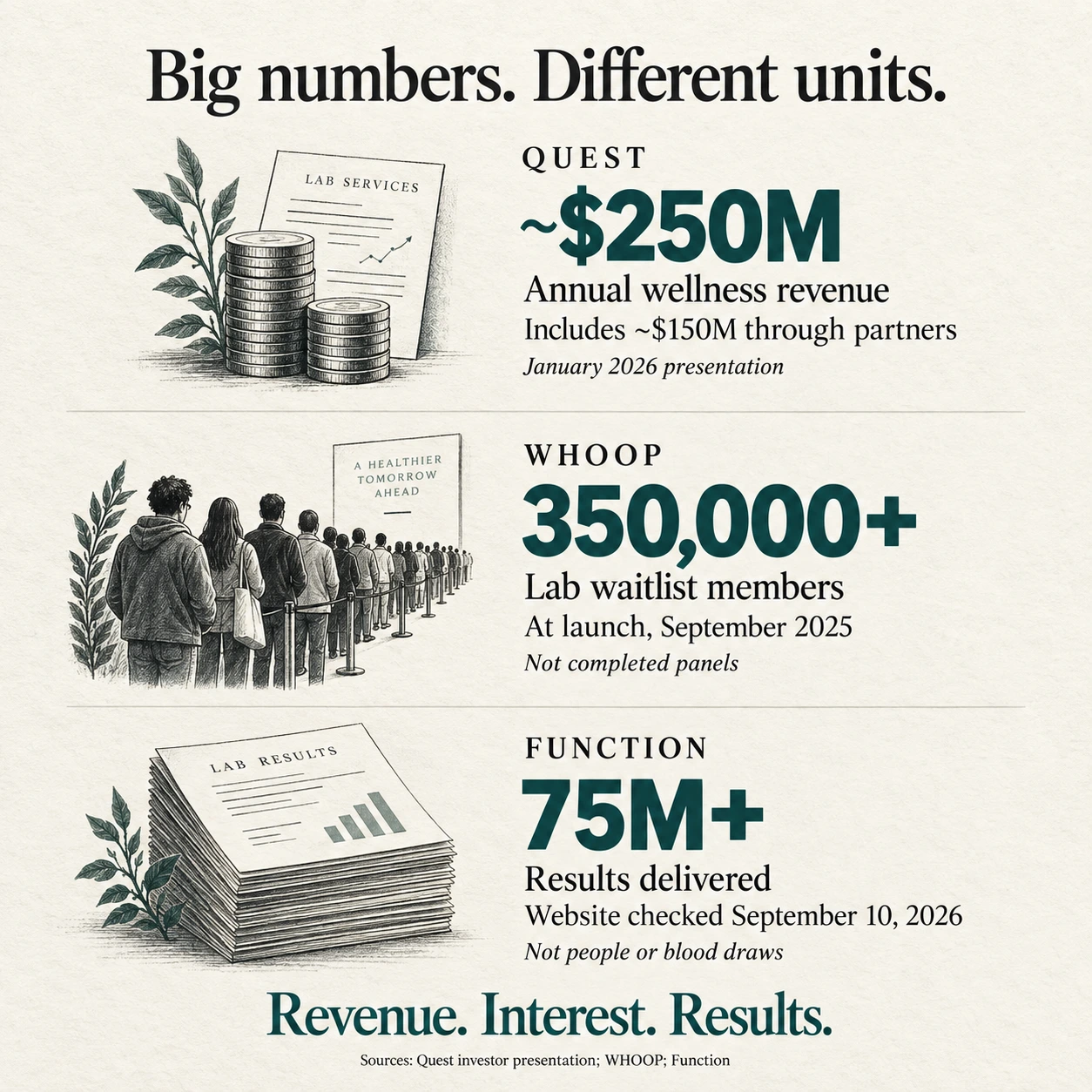
Quest's January investor presentation showed about $250 million in annual wellness revenue, including roughly $150 million through partners. The slide named Function, WHOOP, Hims & Hers, and Oura, without breaking out each company's contribution. Quest, slide 12
WHOOP reported more than 350,000 members on its lab waitlist at launch. Function now reports more than 75 million results delivered. Those are a lot of interested people and a lot of results. Notably, these aren't counts of paid panels or repeat customers. One blood draw can produce many results. WHOOP launch, Function
Revenue, interest, and results measure different things. Quest’s January 2026 presentation includes roughly $150 million through partners. WHOOP’s figure is a launch waitlist, not paid panels. Function’s September 10 counter counts results, not people or blood draws.
Oura's IPO filing describes its labs, but I couldn't find separate figures for lab orders, repeat testing, or lab revenue. Oura S-1
WHOOP also says eight in ten lab users report a meaningful health finding. I'd really like to read the follow-up to that sentence. How many needed treatment? How many changed something that helped? How many ended up doing more tests without a useful answer? The announcement doesn't tell us. WHOOP's August update
As for Apple's panel, I still haven't found the complete test list. Before getting excited about “50+ biomarkers,” I'd like to know which 50. A longer lab report is very easy to sell. Whether it helps is the more interesting question.
Then there is the age business.
Apple says Health Age can use fitness, resting heart rate, sleep, HRV, and optional labs. I haven't found the full formula, how much the score varies on repeat measurement, or evidence that improving it predicts better health outcomes. Apple
And these products don't all mean the same thing by “age.” Oura's Cardiovascular Age estimates vascular aging from pulse-wave characteristics. WHOOP's Healthspan combines fitness, behavior, and physiological measures. Different ingredients, different calculations, all presented in years. Oura, WHOOP
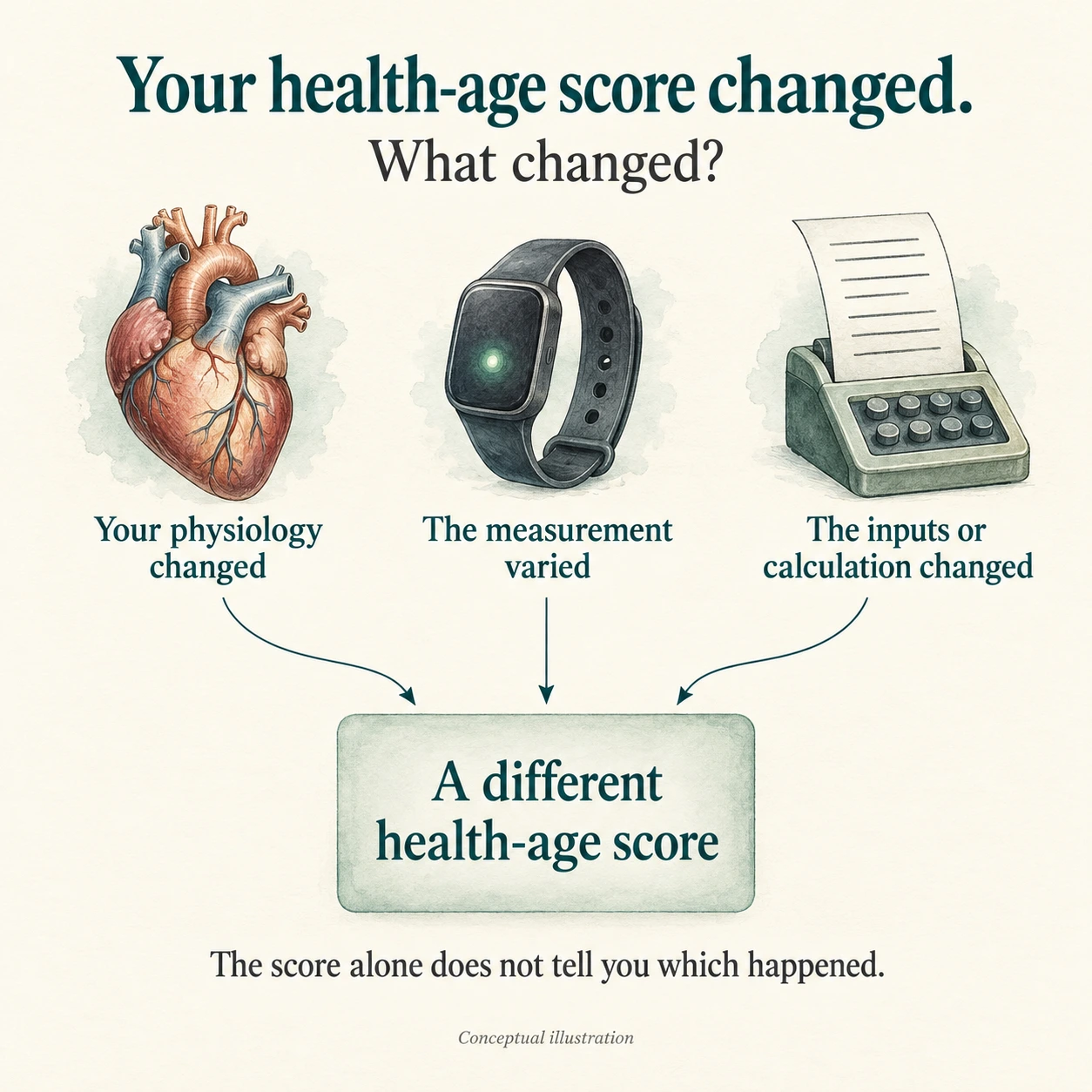
A score might change because you're making sustained progress. Or because you've recovered from a rough week. Or because the app finally got a piece of data it was missing. The number alone is sensitive to many confounders.
A score can be useful without telling you exactly why it moved. Conceptual illustration.
I can see the appeal. “Your health age improved” is easier to connect with than a page of measurements. And at the end of the day, if it gets someone moving, sleeping better, or following up on a risk they've ignored, great. But I'd like to know whether the score adds useful information beyond those measurements.
This is where I've become much more interested in the hardware.
The new watches measure heart rate every five seconds and HRV as often as every five minutes. More frequent collection could fill in gaps. It doesn't automatically make the readings more accurate, however, which is why I wanted to look at Apple's comparison study. Series 12 announcement
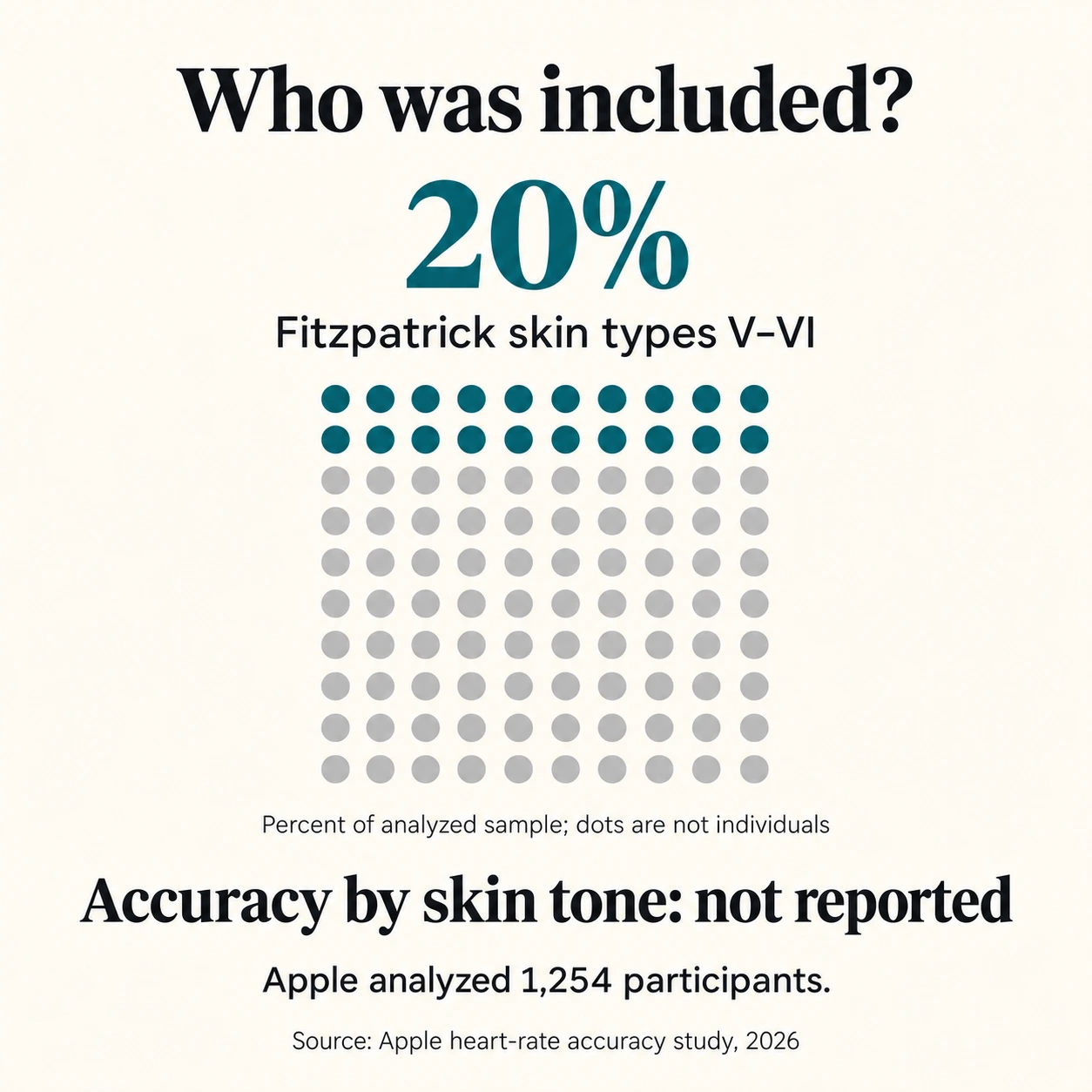
Apple analyzed 1,254 participants, comparing six competing devices against a Polar H10 reference. Its overall workout and daily-activity error measures favored Apple. Twenty percent of participants were in the darker Fitzpatrick skin-type categories V and VI, which is an important addition. The paper didn't report accuracy separately by skin tone, however Apple study
The 100 dots show percentages, not individual participants. Enrollment tells us who participated; results by skin tone are needed to assess performance within those groups.
We have a fairly painful lesson from hospitals about why this matters. A study found that pulse oximeters more often missed low arterial oxygen in Black patients than in White patients. It used race categories, not direct measurements of pigmentation. Heart-rate sensing and pulse oximetry measure different things, so Apple's study doesn't settle the oxygen-saturation question. But it gives us a very good reason to ask whose readings are accurate, rather than stop at the average. Sjoding and colleagues, NEJM
Apple's study also didn't compare the new watch with Series 11. It tells us about performance against the competitors tested, not how much better this year's watch is than last year's. And validating heart rate doesn't validate Health Age or readiness. Study methods
I still find this much more interesting than another score. Good measurements give us something we can keep using as the interpretation improves. Even heart rate needs an algorithm; I'd just like to understand the error in that measurement before asking it to tell me how I'm aging.
The movement tests could be interesting for the same reason. Apple describes camera-guided assessments processed on the device, but I haven't found enough detail about the exercises or validation to judge them yet. Apple
I'd love an easy way to notice when strength or balance is slipping. I'd also like to know that a worse result means my function changed, rather than that I put the phone in a different spot.
All of this makes Oura's IPO timing interesting. It filed its public registration on September 3 and reported five million paid members and 74% revenue growth over the nine months through June. The company is growing. Those numbers don't tell us how its labs are doing, and I haven't found evidence that Apple has changed the offering's terms. Oura filing
I don't think “Apple added a score, therefore Oura is doomed” is a done conclusion. A device you actually like wearing has true value, and as a user of both an Oura ring and an Apple watch, I can confirm there are different use casees for each (I trust the watch more generally with measurements, but can wear the ring into the sauna so that's a big deal).
For health companies, there is also the question of closing the loop.
Suppose a result is abnormal. Does it fit with that person's history, symptoms, medicines, and other tests? Does it need treatment, a repeat test, or no action? And who is going to check back after the person does whatever we've suggested?
Several of these platforms include clinician review. What I want to know is how much follow-up people actually get, and whether their health improves.
That's what I'm watching as Apple gets further into longevity: better measurements, and what people actually do with them.
And yes, sign me up for a new phone and watch.
Hillary Lin, MD Founder & CEO, CareCore
Follow the clinical signal through the whole system.